
Netflix original series 'Road' and 'Can This Love be Translated?', Netflix film 'Good News', and Disney+ original 'Killer's Shopping Mall 2' have one thing in common. It is the participation of Japanese actors.
The presence of Japanese actors in productions that are being produced or released has significantly increased compared to the past. While the variety of faces seen by viewers can be seen as a positive aspect, there are significant concerns about the involvement of actors with historical controversies.
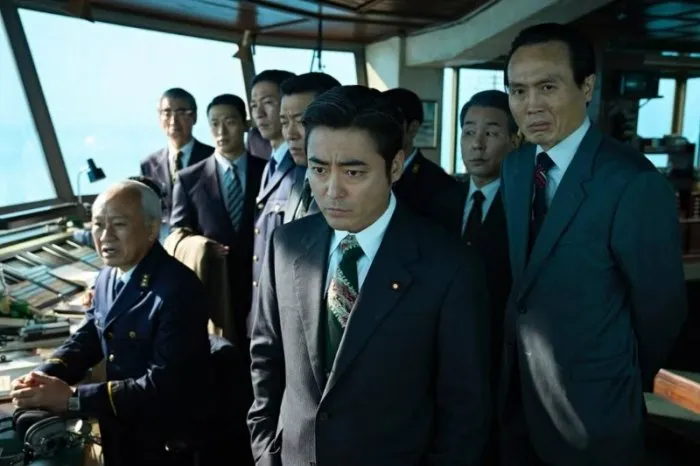
The Netflix film 'Good News', set to be released in October, depicts the suspicious operations of a group of people trying to land a hijacked plane at any cost in the 1970s. Among the cast are Korean actors Seol Kyung-gu, Ryu Seung-beom, and Hong Kyung, alongside Japanese actors such as Takayuki Yamada, Gippei Shina, Nairu Yamamoto, and Sho Kasamatsu. As the work is inspired by the 'Japan Airlines Flight 351 Hijacking Incident' that occurred in 1970, a large number of Japanese cast members join the ranks to collaborate with Korean actors.
In 'Road', directed by Han Jun-hee, known for the Netflix original series 'D.P.' and 'Weak Hero Class', actors Son Seok-koo, Kim Shin-rok, Choi Sung-eun, and Jung Jae-young appear, with Japanese actor Eita Nagayama joining the cast. 'Road' tells the story of two detectives from Korea and Japan chasing a series of horrific murders that transcend borders, involving twisted corpses and mysterious messages. Since the process of joint investigation by the two countries' police is portrayed, the inclusion of Japanese actors seems necessary. Han Jun-hee explained the intent behind the project, stating, "It is a transnational narrative detective story that fiercely tracks the process of the two detectives doing their utmost to catch the perpetrator."
In the sequel 'Killer's Shopping Mall 2' to the production in which Lee Dong-wook appeared last year, Japanese actor Masaki Okada is set to expand the universe further. 'Killer's Shopping Mall' dealt with the survival story of his niece Jian (played by Kim Hye-jun), who became the target of suspicious killers due to the dangerous legacy left by his uncle Jin-man (played by Lee Dong-wook). Upon the release of Season 1, the show received praise from domestic and international media and viewers for its solid narrative and thrilling tension, leading to the confirmation of Season 2 after two years. In 'Killer's Shopping Mall 2', Masaki Okada transforms into Jay, the joint team leader of mercenaries for the East Asia branch of Babylon and the younger brother of Q (played by Hyun-ri).

However, reactions to Japanese actor Fukushi Sota's participation in the Netflix original 'Can This Love be Translated?' expected to be released in the fourth quarter of this year are cold. The new work by the star writer Hong Sisters, in collaboration with Netflix, features multilingual interpreter Joo Ho-jin, who unexpectedly becomes the interpreter for global top star Cha Mu-hee, leading to an unpredictable romantic comedy. The work also stars Kim Seon-ho, Go Yoon-jung, Lee I-dam, and Choi Woo-sung, alongside Sota.
In the past, Sota appeared in the Fuji TV documentary 'Please Teach Us About War' aired in 2015, where he conducted interviews with kamikaze survivors. At that time, Sota shed tears, saying "my grandfather was a candidate for the special attack squad" and expressed admiration for his grandfather.
Kamikaze was a special attack unit organized by Japan to conduct suicide attacks on Allied naval fleets during the latter part of World War II, and a considerable number of Koreans are also known to have been conscripted. Furthermore, the kamikaze is regarded as one of the symbols of Japanese imperialism along with the war flag. As a result, anger over Sota's participation has erupted online. However, since the production format is pre-made, having wrapped filming last February, it seems unlikely that Sota's departure will happen.
Recently, the actor Kentaro Sakaguchi, who has been at the center of a personal scandal, appeared in the Coupang Play series 'Things That Come After Love', which has reportedly increased the recognition of Japanese actors in Korea. Additionally, as the global status of Korean OTT content, such as 'Squid Game', has risen, the participation of Japanese actors in Korean works has notably increased.
While a Korean-Japanese actor combination may be seen as a positive sign for the diversity and global expansion of Korean content, it seems necessary to exercise more caution in choices to avoid the potential of negative issues destabilizing the status of credible Korean content.