

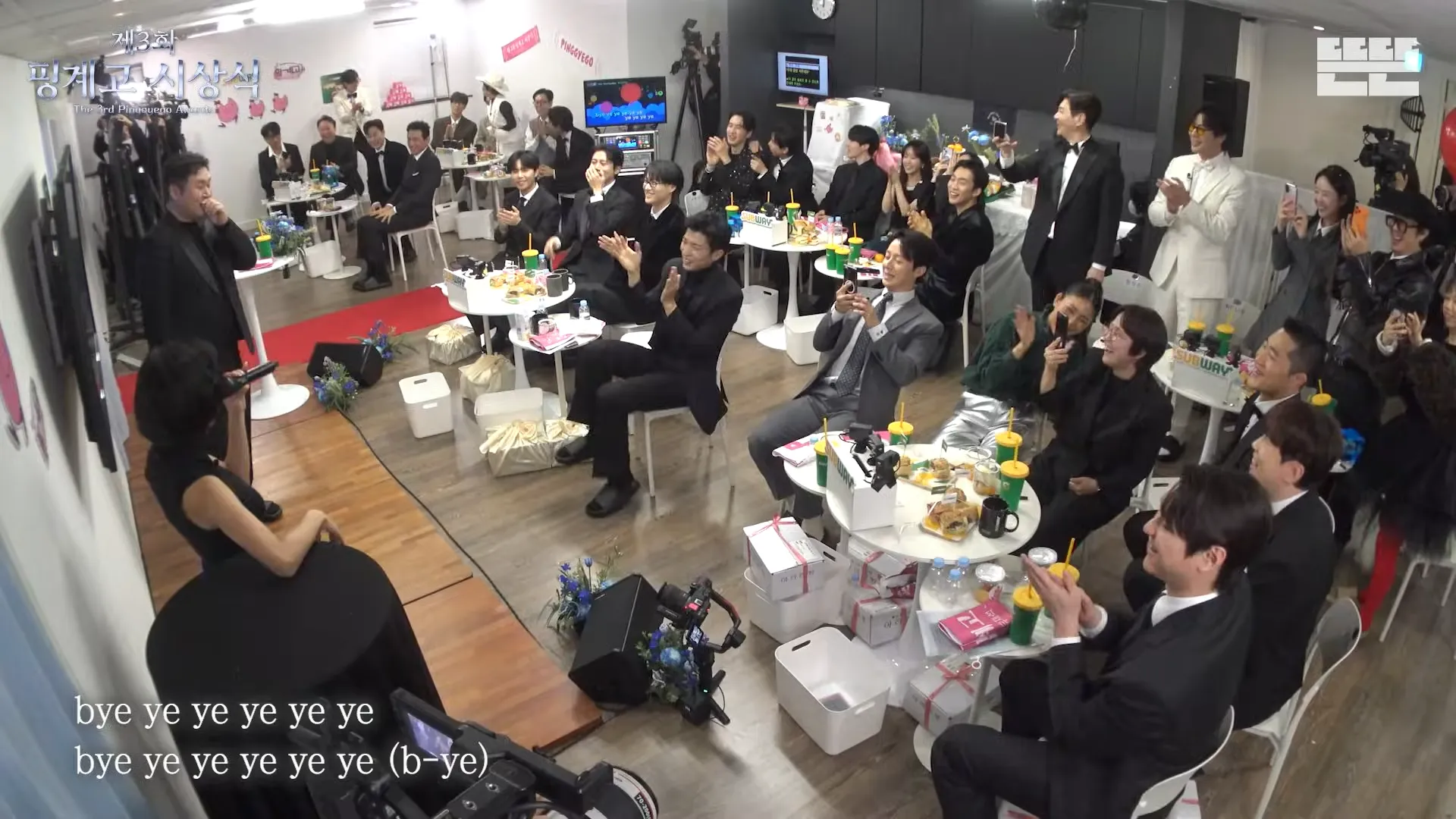
Every year-end, Korea's big three terrestrial broadcasters — KBS, MBC, and SBS — roll out their 'Entertainment Awards.' But the real buzz is increasingly happening off TV. Enter YouTube channel DdeunDdeun's 'Pinggyego Awards,' which has exploded beyond a 'YouTube version of the Entertainment Awards' to become viewers' new year-end ritual. With no massive stage or flashy set, why are fans going wild for the 'Pinggyego Awards'?
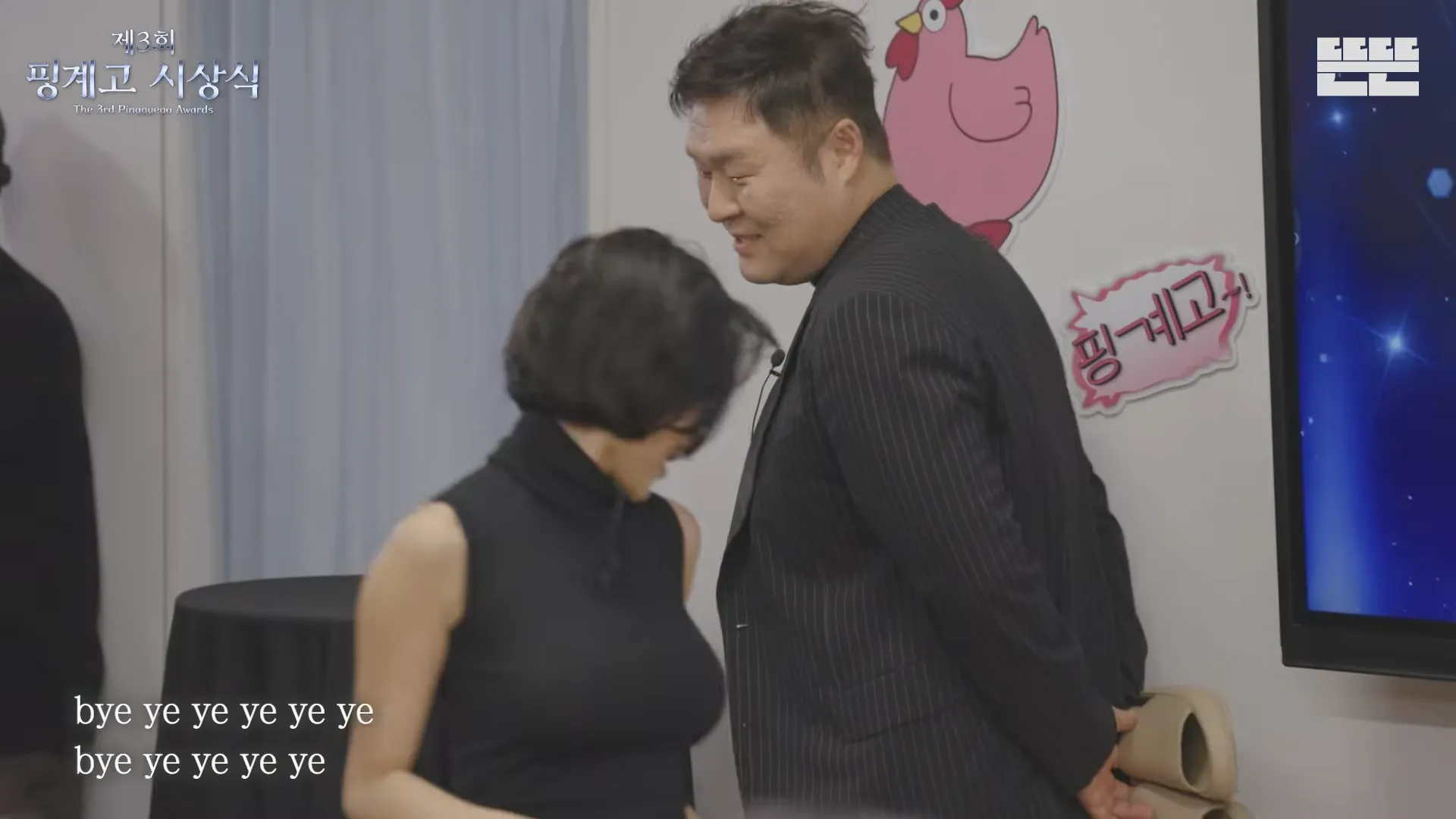
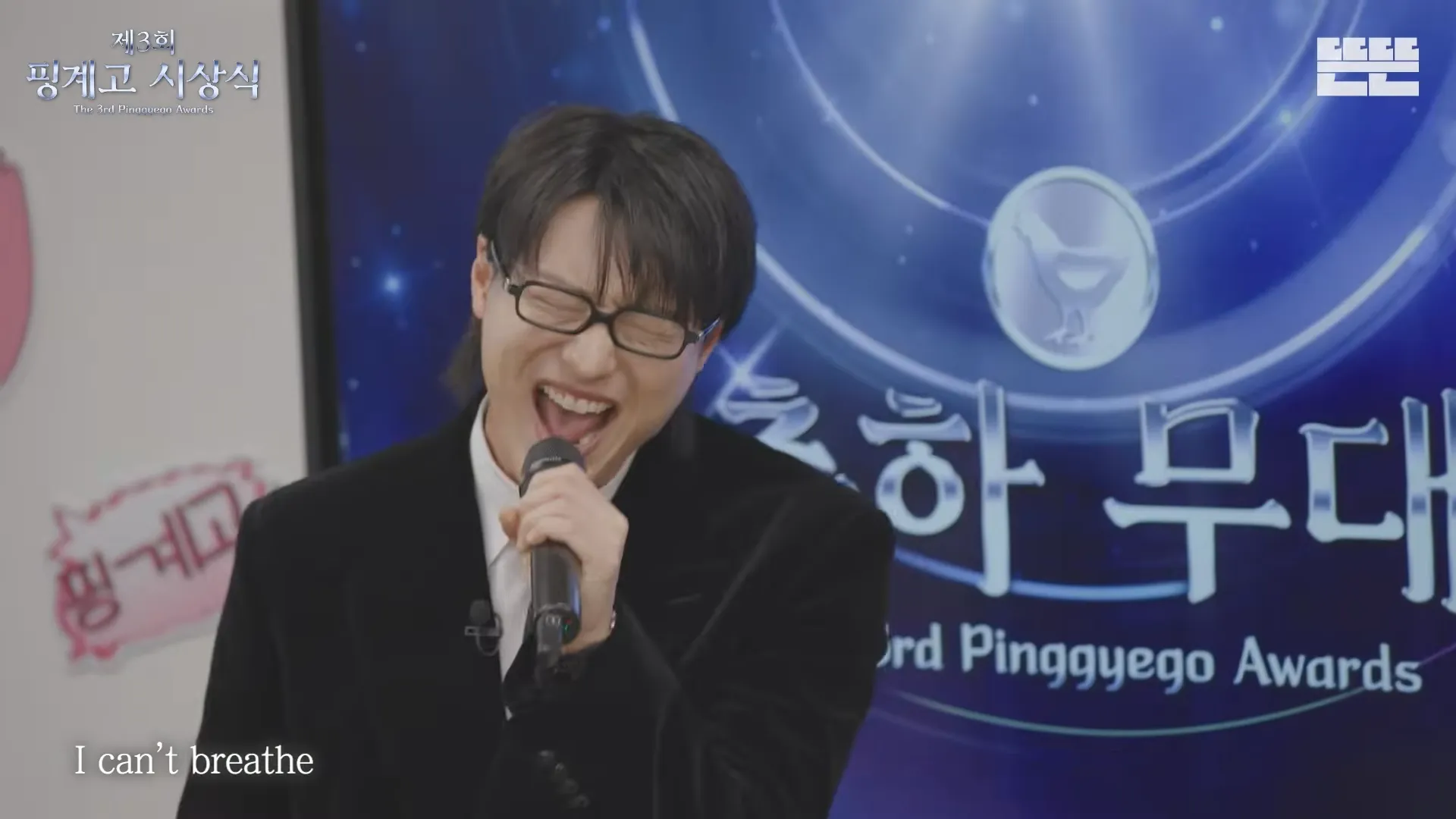
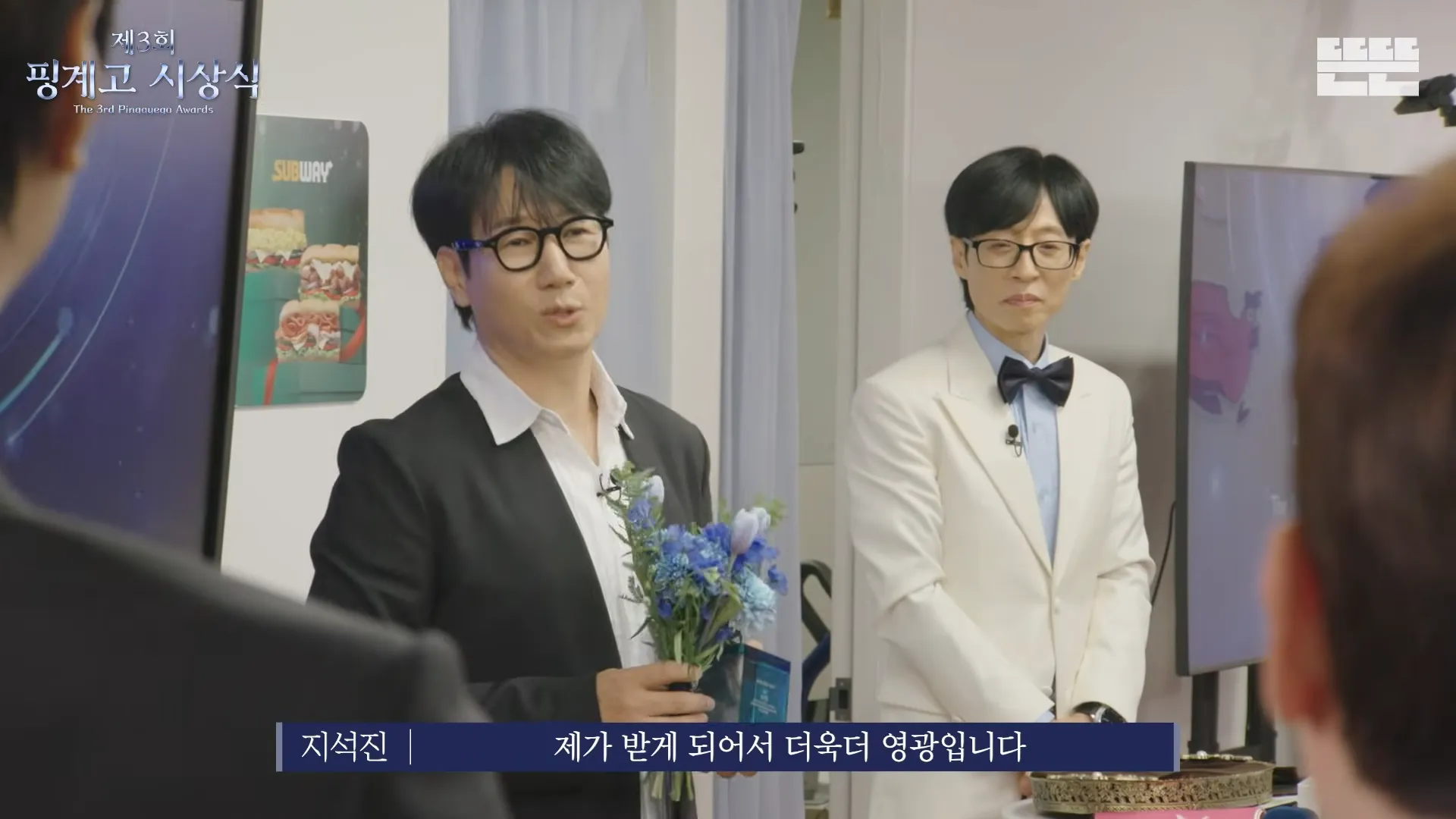
Released on the 21st, the '3rd Pinggyego Awards' racked up 3.42 million views in just one day despite its hefty 2-hour-30-minute runtime — proof of its blazing popularity. This year's show delivered major moments, from Jee Seok-jin's Grand Prize to WOODZ's live performance and a buzzy stage by Hwasa and Yoon Kyung-ho.
The secret weapon is the content's firepower. The '1st Pinggyego Awards,' which dropped in 2023, surpassed 12.8 million views even with a runtime of over two hours, hinting at its breakout potential. The '2nd Pinggyego Awards,' released last year, also drew 9.77 million views over 2 hours and 17 minutes with a star-studded guest list of Pinggyego regulars. So what exactly keeps viewers choosing it?
First, audience power is felt through experience, not just voting. The 'Pinggyego Awards' puts member (subscriber) votes front and center. With standard categories like Grand Prize, Best Work, Top Excellence, Excellence, and Rookie of the Year, it clearly states that the Grand Prize, Best Work, and Popular Star Award are 100% determined by votes — amplifying the feeling of "an award I chose." In contrast, terrestrial award shows often feel like "awards handed out by the network," even when they push viewer participation. To many viewers, the results seem like products of behind-the-scenes calculus rather than a true reflection of their choices.
Second, it's more about wrapping up the storyline than just giving trophies. The 'Pinggyego Awards' gathers a year's worth of episodes, relationships, jokes, and memes into one place — expanding from inside jokes to a shared fan language. The Best Work makes you revisit that specific episode, and the Grand Prize prompts you to retrace the winner's narrative. The rules, like the nomination tally period, are stated clearly, cementing its legitimacy as a proper year-end roundup. Terrestrial awards also show highlights, but with fragmented programming across shows, it's hard for one channel to represent the year's entire variety-show narrative.
Third, the long-form design keeps things engaging. Today's viewers don't hate long videos — they hate long and low-density ones. Even with a lengthy runtime, the 'Pinggyego Awards' minimizes TV-style padding like waiting, set changes, and ad bridges, and the talk rhythm is optimized for YouTube. No wonder it's often cited as proof that "long-form works." Meanwhile, terrestrial award shows can feel like something you watch while skipping around, thanks to layers of ads, congratulatory stages, reaction cuts, and time-splitting.
Fourth, it delivers something more important than "fairness": believability. Terrestrial awards repeatedly face "trophy splitting" controversies whenever categories feel overly segmented or criteria look vague — a common criticism amid slipping ratings. By contrast, the 'Pinggyego Awards' builds trust by explaining criteria more transparently, such as member voting and number of appearances — creating confidence that "at least the rules are clear."
Finally, terrestrial broadcasters celebrate "this year's variety," while Pinggyego celebrates "our time together." If terrestrial awards are industry events, the Pinggyego Awards feel like a community gathering. Even the term "member" addresses viewers as participants, not just an audience. So people tune in less for the authority of the trophies and more to relive "the year I spent with them." That's the spark behind the frenzy.
In the end, audiences aren't rejecting "terrestrial TV" itself — they're rejecting award shows that still try to persuade YouTube-era viewers with TV-era logic. The 'Pinggyego Awards' offers a simple fix: make the rules clear, pay off the narrative, and treat the audience like members. For terrestrial awards to win back viewers, they need to agree with them — not on stage size, but on "why this award matters here and now."